

Open for Chapter Submission
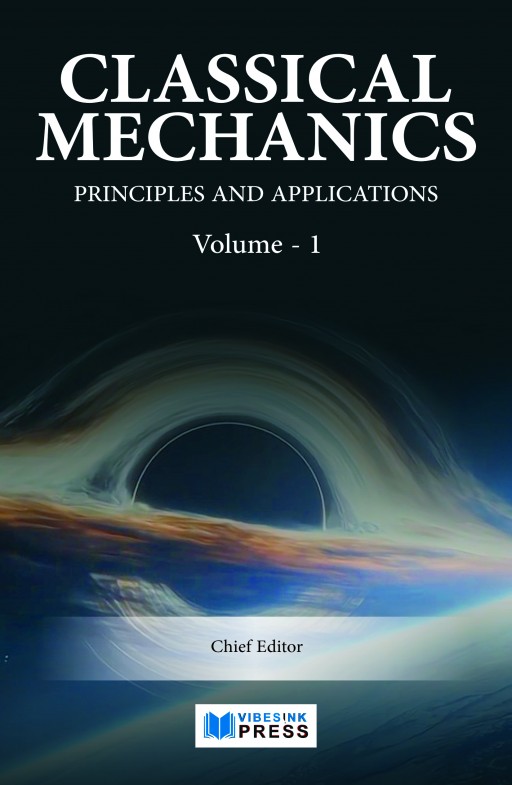
Classical Mechanics: Principles and Applications (Volume 1)
About this book
About the Book
Classical Mechanics: Principles and Applications provides a comprehensive introduction to the fundamental concepts of classical mechanics, focusing on the principles that govern the motion of objects. The book covers key topics such as Newton's laws of motion, energy conservation, rotational dynamics and the behavior of systems under external forces. It also delves into more advanced applications, including harmonic oscillators, central force problems and the dynamics of rigid bodies. By bridging theory with practical applications, the book helps readers understand how classical mechanics principles are used to explain real-world phenomena, from everyday motion to complex engineering problems. This volume is an essential resource for students and professionals in physics, engineering and related fields.
“Collaborative research today builds the resilient communities of tomorrow.”
Scope
Scope of the Book
Suggested topics and areas of interest for this volume:
This book is designed to provide an in-depth understanding of the principles and applications of classical mechanics. It covers the fundamental laws of motion and the mathematical tools needed to describe the behavior of physical systems under various forces. The book will explore both the theoretical foundations and practical applications of classical mechanics
including the dynamics of particles
rigid bodies
and continuous systems. Emphasis will be placed on solving real-world problems using analytical and computational methods. This book is intended for undergraduate and graduate students in physics and engineering
as well as professionals seeking to enhance their knowledge of classical mechanics. Topics to Cover: Principle of Least Action
Variational Principles in Mechanics
D'Alembert's Principle and Virtual Work
Euler-Lagrange Equations
Canonical Transformations
Poisson Brackets and Hamilton-Jacobi Theory
Small Oscillations and Normal Modes
Gyroscopic Motion and Precession
Mechanics of Deformable Bodies
Relativistic Mechanics
Symmetries and Conservation Laws in Mechanics
Stability and Perturbation Theory
Nonlinear Oscillations and Bifurcation Theory
Advanced Topics in Celestial Mechanics
Applications of Classical Mechanics in Modern Engineering
Numerical Methods in Classical Mechanics
Dissipative Systems and Damping
Classical Mechanics in Electromagnetic Systems
Mechanical Waves: Sound and Elastic Waves
Introduction to Quantum Mechanics from Classical Principles
Contributors
Who Can Submit a Chapter?
Contributors should ensure that their proposed chapter is relevant to the scope and requirements of this book.
Research Scholars
Faculty Members
Academicians
Researchers
Subject Experts
Professionals with relevant expertise
Why publish here
Why Publish in This Volume
Requirements
Chapter Submission Requirements
Prepare your manuscript according to the chapter guidelines. Full requirements are in the downloadable guidelines PDF.
- Original manuscript suitable for an edited academic volume
- Abstract
- Author name(s) and contact details
- Affiliation / institutional details
- References in a consistent academic format
- Formatting as described in the chapter guidelines
- Declaration / originality statement as required in the guidelines
- Permissions for any third-party material used
Process
How to Submit Your Chapter
Submission does not automatically mean acceptance. Timing depends on revisions and the editorial schedule for this volume.
01Review the OpportunityRead the scope, topics and contributor requirements.
02Prepare Your ChapterFollow the applicable chapter guidelines.
03Submit Your ChapterUse the author dashboard submission form.
04Editorial ReviewEditorial review, and peer review where this volume requires it.
05PublicationAccepted contributions proceed through production; ISBN for the volume, DOI for the chapter.
Transparency
What Authors Should Know
- Review this book’s scope before submission.
- Requirements may vary by opportunity.
- Submission does not automatically mean acceptance.
- The submission deadline shown on this page is Open now.
- Authors should follow the applicable chapter guidelines.
Explore all current book chapter opportunities → Explore book publishing options →
Editorial opportunity
This Volume Needs an Editor
Editor needed
No editor is assigned to Classical Mechanics: Principles and Applications (Volume 1) yet. If you have subject expertise and academic experience, you can apply to lead this edited book.
- Guide chapter submissions in your subject area
- Support editorial quality and peer review where required
- Be acknowledged as editor of the published volume
Questions
Frequently Asked Questions
A fixed submission deadline is not listed for this opportunity yet. This volume is open for chapter submissions. Contact the editorial team if you need a timeline for this title.
Researchers, academicians, faculty members, subject experts and professionals with relevant expertise may submit when their work fits this volume’s editorial scope. Review the scope and guidelines before submitting.
Suitable contributions should align with this book’s stated scope (Science). Review the Scope & Topics section on this page and the chapter guidelines before preparing your manuscript.
Follow the Chapter Guidelines PDF for manuscript format, references, figures/tables, originality and permissions. Volume-specific instructions on this page take priority where provided.
Use Submit Your Chapter to open the author dashboard submission form (sign in or create an account if needed). You can also contact the editorial team if you have questions before submitting.
Current general fees shown on this page are ₹800 for Indian authors and US$20 for international authors, from publishing settings. Confirm the amount before payment.
Yes. A hard copy is available as an optional add-on for ₹500 / US$10.
The editorial team acknowledges the submission and assesses fit and presentation. You may be asked to revise. Peer review is used where this volume requires it. Submission does not automatically mean acceptance.
Contributors should ensure the proposed chapter is relevant to the scope and requirements of this book. Submissions outside the stated scope are less likely to proceed.
ISBN is assigned to the published edited volume. DOI is provided for published book chapters. Identifiers are applied as part of the publication process for accepted contributions.
More opportunities
Related Book Chapter Opportunities
Other edited volumes currently listed for chapter submission.



Explore
Related Publishing Paths
Share Your Research. Make an Impact.
Submit your chapter to Classical Mechanics: Principles and Applications (Volume 1) or speak with the editorial team.